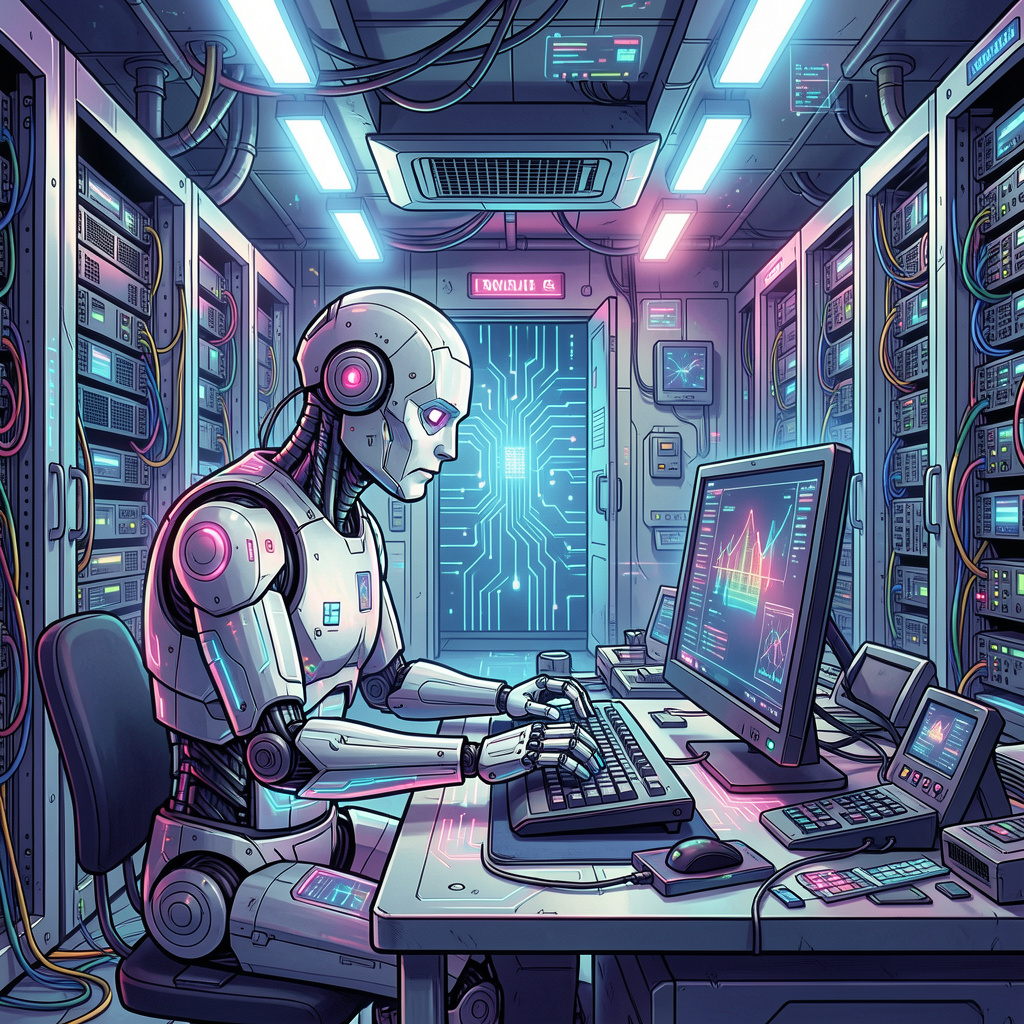
AI is already changing how technology work gets done.
That doesn’t necessarily mean businesses will need fewer technology professionals. It may mean they need different capabilities from the people they hire.
As AI takes on more routine technical tasks, technology professionals may spend less time producing work manually and more time reviewing, directing and improving what AI produces.
For employers, that creates a different question from simply asking whether AI will replace jobs.
What will your technology team need to be good at when AI is doing more of the work?
Is AI replacing technology jobs or changing them?
The answer is likely to be more complicated than either “AI will replace everyone” or “AI will change nothing”.
Skills England’s 2026 assessment of the digital and technologies sector describes AI as reshaping jobs and workflows, with evidence of a shift away from routine coding and testing towards oversight, verification and communication, alongside greater emphasis on judgement and accountability.
It also identifies growing demand for adaptability, accountability, collaboration and the ability to use AI alongside technical expertise.
That points towards a change in the composition of technology work rather than a simple replacement of technology professionals.
The Office for National Statistics found that self-reported AI use among UK businesses with 10 or more employees had increased from around 12% in late 2023 to around 35% in June 2026.
Importantly, businesses are not primarily responding by replacing their existing workforce. Training or retraining existing employees was the most commonly reported way of integrating AI-related skills, while around 10% of businesses reported automating or replacing roles with AI.
The picture is therefore more nuanced than the headlines often suggest.
AI can do more of the work. Someone still has to own it.
One of the biggest changes for technology teams may be the movement from doing the task to owning the outcome.
An AI system might generate code.
A person still needs to determine whether that code is appropriate.
AI might identify a potential security issue.
Someone still needs to decide how serious it is, what action to take and what risk the business is prepared to accept.
AI might analyse a large dataset.
Someone still needs to understand what the analysis means for the organisation and whether the conclusions are reliable enough to act on.
As AI becomes more capable, these responsibilities don’t necessarily disappear.
They can become more important.
This is particularly relevant for senior technology roles, where accountability, judgement and communication are already central to the job.
What skills will technology teams need as AI improves?
The technical skills businesses need will not disappear.
They may, however, be joined by a broader set of capabilities.
Technology professionals increasingly need to understand how to use AI tools effectively, assess their outputs and incorporate them into existing workflows.
That requires more than knowing how to write a good prompt.
Skills England’s 2026 AI Foundation Skills for Work benchmark identifies three broad areas of AI capability: technical, non-technical, and responsible and ethical skills. These include using AI tools effectively, communicating AI-generated outputs, adapting to AI-supported ways of working, and understanding issues such as accuracy, bias, privacy and security.
That creates an interesting shift in what employers may look for.
A technology professional who can use AI to complete a task faster is useful.
A technology professional who can determine which task should be automated, how it should be implemented, what could go wrong and how the result should be governed may be considerably more valuable.
AI may change what “senior” means
There is another consequence for technology recruitment.
If AI reduces the amount of time people need to spend on certain technical tasks, seniority may increasingly be demonstrated through judgement rather than volume of output.
A senior professional may not be the person who writes the most code, produces the most documentation or completes the most technical tasks.
They may be the person who can:
- Decide where AI should and should not be used
- Identify when an AI-generated result is unreliable
- Translate technical possibilities into business decisions
- Manage risk and accountability
- Lead people through changes to how work is performed
- Connect technology decisions to commercial outcomes
- Challenge assumptions made by both people and technology
That doesn’t make technical expertise less important.
It changes how that expertise is applied.
Does this mean businesses should hire fewer technology professionals?
Not necessarily.
It may mean businesses need to think more carefully about what each technology role is actually responsible for.
If AI can automate part of an existing role, there are several possible outcomes.
The business could reduce the amount of work required.
It could use the additional capacity to take on more work.
It could redesign the role around higher-value activities.
Or it could combine technology capabilities that previously sat across several different roles.
There is no single answer because the outcome depends on the organisation, its technology maturity and how effectively it implements AI.
The ONS evidence also suggests that AI skills are not yet widespread across entire workforces. It found that training or retraining existing staff was the most common way businesses were integrating AI-related skills, but only 11% of businesses with 10 or more employees reported that more than half of their workforce had received AI-related training.
That creates an opportunity.
The people already in the business may have more potential to adapt than their current job descriptions suggest.
What does this mean for technology recruitment?
It means businesses may need to reconsider what they are actually hiring for.
A traditional technology vacancy might focus heavily on specific platforms, programming languages, systems or years of experience.
Those requirements may still be essential.
But they may not be enough.
If the role will involve working alongside AI, employers should also consider whether candidates can demonstrate:
Judgement: Can they assess whether a technology-generated result is appropriate?
Adaptability: Can they learn new tools and change the way they work?
Problem-solving: Can they define the problem before reaching for a technology solution?
Communication: Can they explain technical outputs and risks to people who are not technical specialists?
Commercial awareness: Can they understand the consequences of technology decisions for the wider business?
Accountability: Can they take ownership of an outcome rather than simply completing a task?
These are not exclusively AI skills.
They are capabilities that become more valuable when technology can take on more of the execution.
The best technology hire may not be the most technical candidate
AI could therefore change technology recruitment without eliminating the need for technology professionals.
As routine work becomes easier to automate or augment, businesses may place greater value on people who can direct technology effectively.
That could change the profile of a strong technology hire.
The best candidate may not be the person who can personally perform every technical task faster than everyone else.
They may be the person who understands what needs to happen, knows how technology can help, recognises where it can fail and can take responsibility for the result.
For businesses, that means the question is no longer simply:
“Can this person do the work?”
It may increasingly become:
“Can this person make good decisions about how the work should be done?”
AI won’t remove the need for technology leadership
The more capable AI becomes, the easier it may be to assume that technology teams should become smaller.
But technology adoption also creates new questions around governance, security, integration, risk, skills and organisational change.
Someone still needs to answer those questions.
For some businesses, that may mean changing existing roles rather than immediately adding new ones.
For others, it may mean hiring people with broader technology leadership capabilities than they previously needed.
Either way, AI is unlikely to make technology leadership less important.
It may make it more important.
The businesses that benefit most from AI will not necessarily be those that replace the most people.
They may be those that understand which work should be automated, which work should be augmented, and where human judgement remains essential.
At Bristow Holland, we help businesses identify technology professionals based on the capabilities they need now – and the capabilities they are likely to need as their technology function evolves.
If AI is changing what you expect from your technology team, it may be time to reconsider what you expect from your next technology hire.
Contact Andy Bristow